
Types of Solar Irradiance Meters: What Do You Really Need for PV Testing?
Solar irradiance is one of the most important factors when assessing the performance of a photovoltaic system. But not every solar irradiance instrument is designed for the same purpose.
From sophisticated laboratory instruments to handheld PV meters and simple reference sensors, there are several ways to measure or monitor the solar energy falling on a PV module.
Why measure solar irradiance?
A solar panel cannot be judged fairly simply by looking at its electrical output at one particular moment.
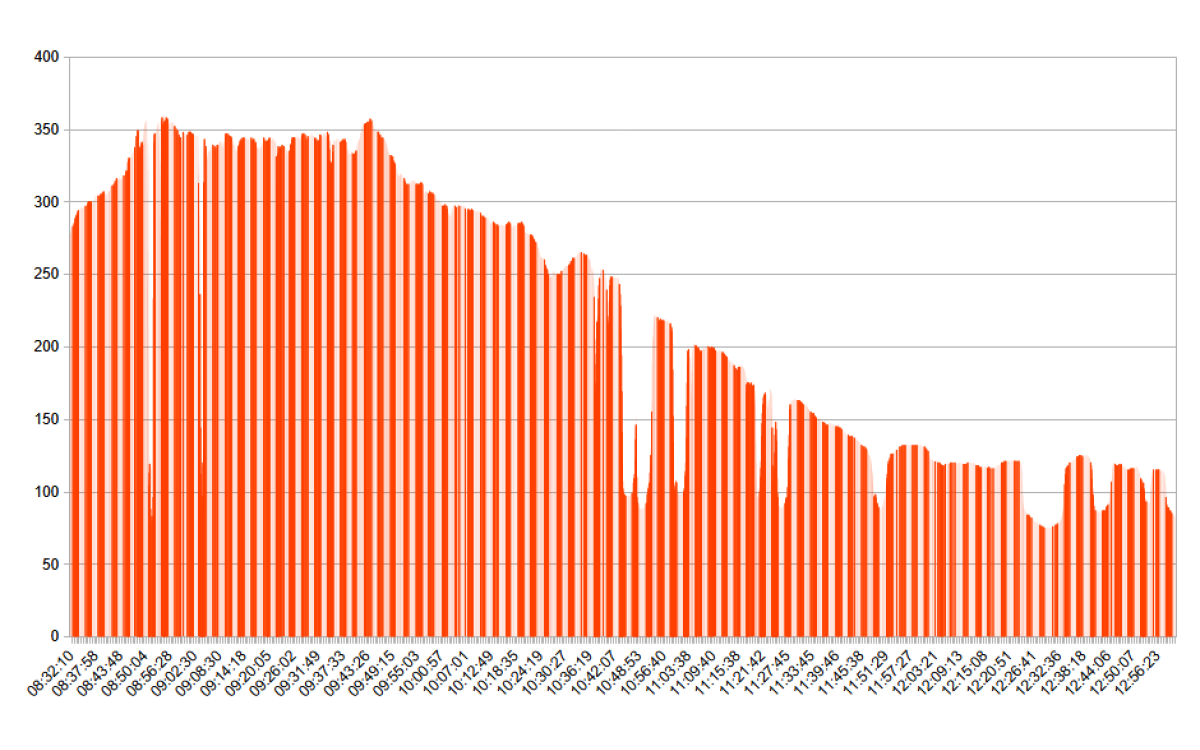
Solar irradiance changes continuously with the position of the sun, clouds, haze, shading, atmospheric conditions, panel orientation and time of day.
A PV string producing less power than expected may therefore have a genuine electrical or module problem — or it may simply be receiving less sunlight at the time of measurement.
Before comparing PV performance, you need to understand the sunlight conditions under which the comparison was made.
This is why irradiance measurement is commonly used during PV installation, commissioning, troubleshooting and performance assessment.
What is solar irradiance?
Solar irradiance describes the power of electromagnetic radiation received on a surface from the sun. It is normally expressed in watts per square metre (W/m²).
For a PV system, the amount of irradiance reaching the module is closely related to the amount of electrical power the module can potentially produce, although actual output is also affected by module temperature, electrical losses, shading, mismatch, inverter behaviour and other factors.
This means that irradiance measurement should generally be considered together with the electrical measurements and operating conditions of the PV system.
The main types of solar irradiance instruments
There is no single "best" irradiance meter for every situation. Different instruments exist because solar measurement can have very different requirements depending on whether the application is scientific research, site assessment, PV installation, maintenance or simple comparative checking.
1. Pyranometers
A pyranometer is a professional instrument designed to measure solar radiation received from a broad portion of the sky. It is widely associated with meteorological and solar-resource measurement applications.
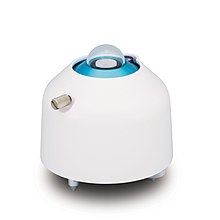
Higher-grade pyranometers can be sophisticated instruments requiring careful installation, levelling, maintenance and consideration of their response characteristics.
They are particularly relevant when the objective is to obtain high-quality solar radiation measurements for scientific, meteorological or solar-resource applications.
2. Pyrheliometers
A pyrheliometer is designed primarily to measure direct solar radiation. Unlike a pyranometer, which has a much broader field of view, a pyrheliometer is normally used with a tracking system so that it remains aligned with the sun.
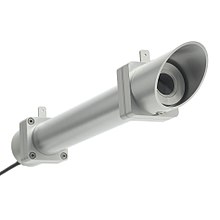
These instruments are therefore more commonly associated with research, solar-resource studies and specialised measurement applications than with routine homeowner PV checking.
3. Reference-cell irradiance sensors
Another approach uses a reference photovoltaic cell whose electrical response is related to incident solar irradiance.
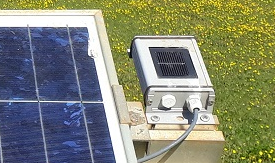
Reference-cell based instruments can be particularly useful in PV applications because the sensor technology itself has a relationship with photovoltaic response.
However, the accuracy and usefulness of any instrument depend on its design, calibration, spectral response, temperature characteristics, angle of incidence and intended application.
4. Handheld solar irradiance meters
Handheld instruments are popular with PV installers and technicians because they are portable and can provide an immediate irradiance reading at the installation site.
Some models also combine several useful functions in one instrument.
For example, the Fluke FLK-IRR1-SOL provides solar irradiance measurement together with temperature measurement, compass and inclination functions. Fluke specifies an irradiance measuring range of 100 to 1400 W/m² and an accuracy of ±(5% + 5 digits) under its stated test conditions.
Such a device can therefore be useful where the technician needs an immediate numerical irradiance measurement together with information about the physical orientation of the PV array.
Comparing the different approaches
| Instrument / approach | Typical purpose | Typical user | Main consideration |
|---|---|---|---|
| Pyranometer | Solar radiation and resource measurement | Research / professional measurement | Instrument quality, installation and calibration |
| Pyrheliometer | Direct solar radiation measurement | Research / specialised applications | Requires accurate solar alignment and specialised setup |
| Reference-cell sensor | PV-related irradiance measurement | PV testing / engineering | Calibration, spectral response and sensor characteristics |
| Handheld irradiance meter | Installation, commissioning and field checking | Installers / technicians / PV owners | Accuracy, functions, portability and cost |
| PVBuddy PVS01 | Comparative PV field checking | PV owners, early adopters and module checking | Establishing a practical reference for repeat comparison |
Does every PV owner need a laboratory-grade measurement?
This is an important question because "accuracy" and "usefulness" are not always the same thing.
If a measurement is required for a formal certification, laboratory comparison, contractual requirement or a regulated test procedure, the appropriate certified or traceable instrument and procedure should be used.
For everyday PV maintenance, however, another question can be equally useful:
For example, if a PV owner establishes a reference for a particular string and subsequently repeats the measurement under reasonably comparable sunlight conditions, a change from the established reference can provide an early indication that further investigation may be worthwhile.
This is a different objective from proving an absolute irradiance value to laboratory standards.
Why sunlight stability matters
Irradiance can change surprisingly quickly. A cloud moving across the sun can cause a substantial change in the sunlight received by a PV module within a short period.
Consequently, comparing two measurements taken under completely different sunlight conditions can produce a misleading conclusion.
For comparative PV checking, it is therefore preferable to perform measurements when sunlight is reasonably stable and to keep the sensor orientation consistent.
- Keep the sensor orientation consistent.
- Avoid rapidly changing cloud conditions where possible.
- Compare measurements taken under reasonably comparable conditions.
- Record relevant observations such as shading or unusual weather.
Where does PVBuddy fit?
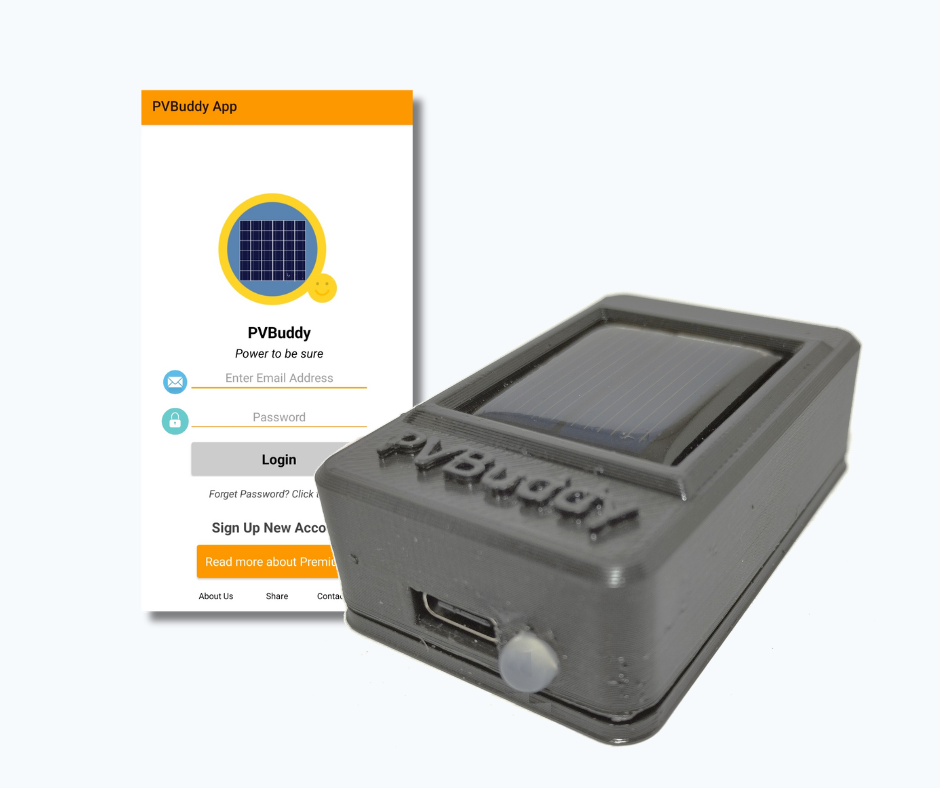
PVBuddy takes a different practical approach to irradiance measurement.
The PVS01 sensor measures irradiance and works with the PVBuddy App. Instead of positioning the product simply as a replacement for laboratory or professional irradiance instruments, PVBuddy is designed around establishing a practical reference that can be used for repeat comparison.
Flexi-Cal™
The PVBuddy approach can be used flexibly.
Where a suitable calibrated irradiance meter is available, the PVS01 can be adjusted against that reference. Alternatively, the sensor can be tuned using the inverter kWh reading of a representative PV string or group of strings having the same orientation.
Once the reference has been established, subsequent measurements can be compared with that reference under suitable, stable sunlight conditions.
This is the idea behind Flexi-Cal™: flexible reference setting for practical PV field checking, rather than claiming that PVS01 replaces a laboratory calibration facility.
A simple PVBuddy reference-setting example
A typical inverter-calibrated reference can be established using three basic steps.
- Select the test area. Place the PVS01 sensor in the same orientation as the PV module or string being assessed.
- Set the reference. Check the inverter kWh reading and tune the sensor through the PVBuddy App for that string or for strings having the same orientation.
- Repeat and compare. Repeat the measurement under comparable, stable sunlight conditions and compare the result against the established reference.
Which type of instrument is right for you?
The right choice depends mainly on what you are trying to accomplish.
If you are conducting scientific solar-resource measurements, a professional radiometric instrument may be appropriate.
If you are installing or commissioning PV systems and need immediate irradiance, temperature and orientation information, a multifunction handheld PV meter can be very useful.
If your objective is to investigate whether your own PV system is behaving differently from its established condition, a simpler comparative approach may be more practical.
"How accurate is the meter?"
It is also:"What decision am I trying to make from the measurement?"
What PVBuddy does — and does not — claim
PVBuddy is intended as a practical comparative PV field assessment tool.
It is not intended to replace certified or traceable measurement equipment where such equipment is required.
Nor should a change in an irradiance-related result by itself be treated as proof that a particular PV component has failed. It should instead be considered an indication that further investigation may be appropriate.
This distinction is important because PV performance can be influenced by many factors including shading, temperature, soiling, wiring, connectors, module degradation, inverter operation and changing weather conditions.
Continue learning about PV system checking
Understanding irradiance is only one part of checking a photovoltaic system.
You may also find our articles on how well a PV system is performing and practical solar panel testing useful.
Want a practical way to check your PV system?
Learn how PVBuddy PVS01 uses irradiance measurement and Flexi-Cal™ reference setting for comparative PV field checking.
View PVS01