
Remote Solar Monitoring Made Simple: Check Your Home Solar System Even When You're at Work!
What if you could check how much electricity your home solar panels are capable of generating without being physically at home?
You don't need an expensive cloud-connected monitoring system or a direct connection to your rooftop solar installation to explore this possibility.
With the PVBuddy PVS01 sensor and its mobile app, you can establish an independent, remote solar monitoring arrangement using sunlight measurements taken at a nearby location.
Here's an interesting DIY approach that could change the way you look after your solar investment!
1. Introduction – Do You Know How Your Solar Panels Are Performing Right Now?
Solar panels work quietly on your rooftop while you're busy at work, travelling or attending to other things.
But do you know whether they are performing as expected?
Most homeowners depend on their inverter's monitoring portal to check daily electricity generation. While useful, this only tells part of the story. Knowing how much sunlight is available and how much energy your PV system should be generating provides another useful perspective.
Do you know that you can use PVBuddy to check your solar system's estimated energy generation remotely, even while you are at work in the same city?
The interesting part is that PVBuddy does not need to connect directly to your rooftop solar system, inverter or its cloud monitoring service.
Instead, you enter your PV system's configuration into the PVBuddy App and use the PVS01 sensor at a nearby location to measure the available sunlight.
With the correct solar panel inclination and orientation replicated, PVBuddy uses the measured irradiance and your entered PV system information to calculate the corresponding estimated energy generation in kWh.
Let's see how you can put this idea into practice!
2. Here's the Idea – Your Own Remote Solar Monitoring Station
The concept is straightforward. You can set up a small DIY solar monitoring station at your workplace, balcony, garden or another suitable location within your city.
Step 1 – Register Your PV System in the PVBuddy App
Start by entering your solar installation details into the PVBuddy App.
This includes the relevant PV panel and string configuration required for the calculation.
For example:
PV panel specifications and rated capacity.
Number of panels in each string.
Relevant string or array configuration.
Other required PV system parameters.
This allows PVBuddy to understand the solar installation you want to monitor.
Once configured, your PVBuddy App has the information needed to calculate the expected PV energy output based on the irradiance measurements obtained from the PVS01 sensor.
Step 2 – Record Your Solar Panel Inclination and Orientation
Here's where the free PVincline App comes in!
Use PVincline to measure and record the inclination and compass orientation of your existing solar panels.
You can record different orientations for different strings or sections of your array.
These measurements become your reference when replicating the actual panel positions at your remote monitoring location.
The beauty of this approach is that you don't need to climb onto your rooftop repeatedly just to obtain these measurements.
Step 3 – Build a Simple Adjustable DIY Platform
Now for the fun part!
Build a small adjustable platform using aluminium sections, wood or other suitable materials.
The platform should allow you to adjust the inclination of the PVS01 sensor to match the recorded inclination and orientation of your installed solar panels.
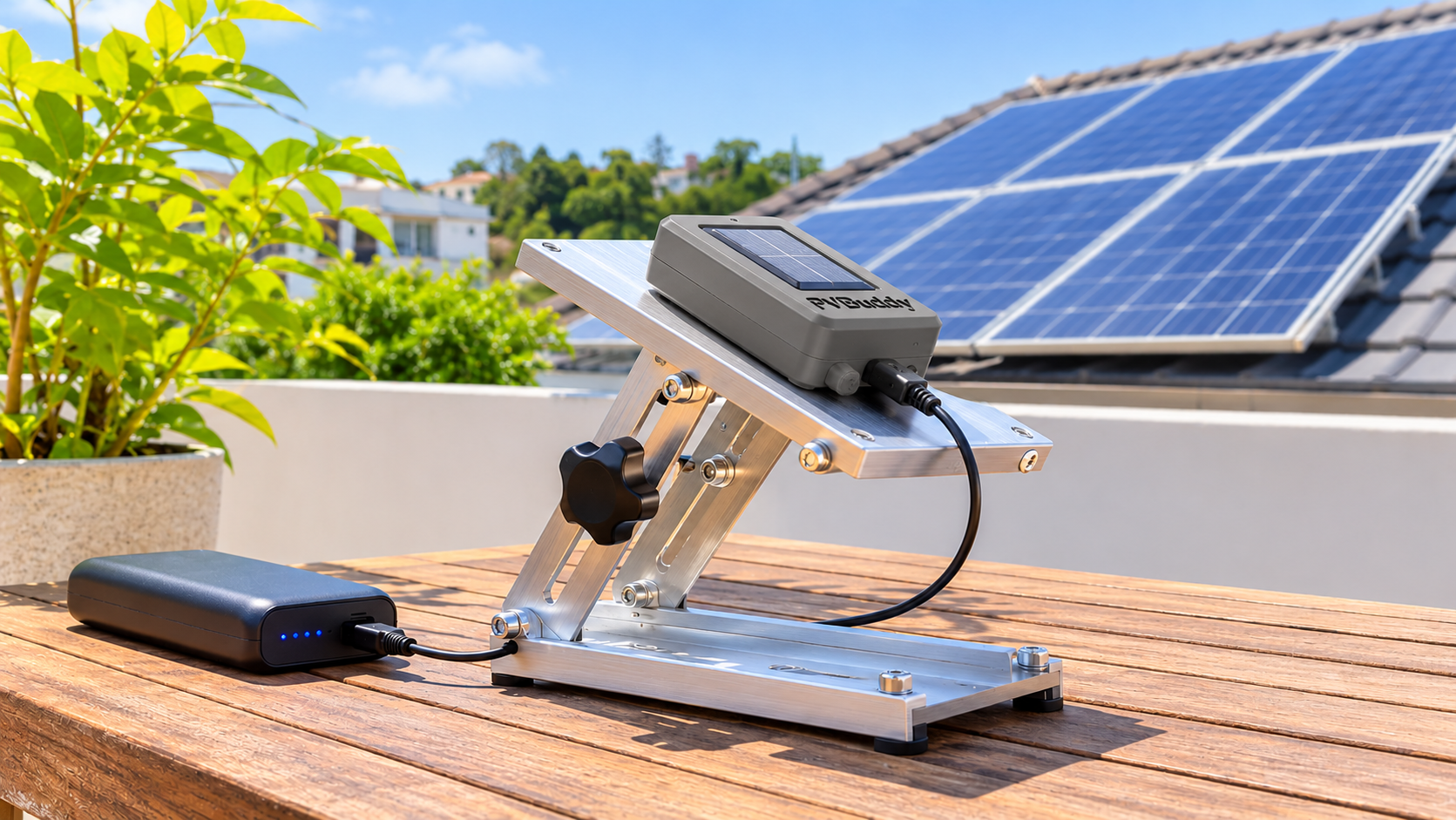
Place your PVS01 sensor on the platform, connect it to a suitable 5V USB power source or power bank, and adjust its position to replicate the solar panel orientation.
Choose a location with good sunlight exposure and minimal obstruction.
Ideally, your monitoring station should be within the same city or a reasonably nearby area where sunlight and weather conditions are representative of your actual PV installation.
Step 4 – Check Your Solar Energy Generation Remotely!
Now comes the interesting part.
Once your PVS01 sensor is positioned correctly, connect it to the PVBuddy App and obtain the irradiance reading.
The app uses the sensor's measured sunlight level together with your previously entered PV system configuration to calculate the corresponding estimated energy generation in kWh.
You can now check the calculated solar energy output without physically visiting your home solar installation!
For example:
Imagine you have a 6 kWp rooftop solar installation at home.
While you are working at your office across town, your PVS01 sensor is positioned on your DIY adjustable platform, replicating the inclination and orientation of your rooftop panels.
The sensor measures the available sunlight, and PVBuddy calculates the corresponding expected energy generation based on your registered PV configuration.
You now have an independent reference to help you understand how your solar installation should be performing under the prevailing sunlight conditions.
No direct inverter connection. No rooftop sensor installation. No dependency on your inverter manufacturer's cloud monitoring service.
Just your PV system data, PVBuddy PVS01 and the sunlight available at your monitoring location.
Step 5 – Cross-Check With Your Inverter's Online Monitoring
For additional confidence, you can compare PVBuddy's calculated kWh figures with the actual energy generation reported by your inverter.
Most modern inverters provide online monitoring through their manufacturer's mobile app or web portal.
Check the following:
Does the calculated energy output from PVBuddy broadly agree with the inverter's actual generation?
Is there an unusual or persistent difference between expected and actual generation?
Has the difference increased over time?
Are there possible changes in shading, panel cleanliness or system operating conditions?
Remember that the PVBuddy calculation is an independent estimate based on the measured sunlight and registered PV system data. It is not a direct measurement of the electricity generated by your rooftop installation.
For meaningful comparisons, use reasonably stable sunlight conditions and account for differences in local weather, shading, panel temperature and other site-specific factors.
3. Conclusion – Early Detection, Smarter Maintenance and Better Solar Returns
Solar panels are designed to last for many years, but they are not maintenance-free.
Dust, bird droppings, shading, ageing modules, electrical faults and other issues can affect the energy generated by your installation.
The biggest challenge for many homeowners is knowing when something has changed.
With PVBuddy's independent irradiance-based monitoring approach, you have another way to assess your solar installation without having to be physically at home.
Here are some potential benefits:
1. Early Detection of Performance Changes
Establish a reference for your PV system and periodically compare its calculated energy output with actual inverter generation.
A persistent or unusual deviation can alert you to investigate further.
2. Save Money on Unnecessary Maintenance
Rather than arranging an EPC service visit whenever you suspect something is wrong, use PVBuddy observations and inverter records to help decide whether further investigation is justified.
3. Know When Your Panels May Need Cleaning
Dust and accumulated dirt can reduce solar energy production.
When your inverter consistently reports less generation than expected under comparable sunlight conditions, panel cleanliness is one of the factors worth investigating.
4. Make Better Use of EPC Service Calls
When you do need professional assistance, you can provide useful historical observations and performance comparisons to help the EPC identify possible causes.
This can make troubleshooting more focused and potentially save time and maintenance costs.
5. Monitor Without Depending on Your Inverter's Cloud Platform
One of the interesting advantages of this approach is its independence.
PVBuddy does not need a direct connection to your inverter or rooftop PV installation for this monitoring arrangement.
You can establish your own nearby irradiance monitoring point and use the PV configuration already entered in your app.
6. Become a More Informed Solar Owner
Instead of simply looking at the kWh figure on your electricity generation dashboard, you gain another perspective on the relationship between available sunlight and your PV system's expected energy output.
It puts you in a better position to understand changes and decide when action may be necessary.
Make Every Ray of Sunshine Count!
Solar energy is one of the most practical ways to reduce our reliance on conventional electricity generation and contribute to a cleaner environment.
But installing solar panels is only the beginning.
Understanding their performance, identifying changes and maintaining your installation are equally important.
With a little DIY creativity, PVincline and PVBuddy PVS01, you can explore a smarter way to keep an eye on your solar investment, even when you're away from home.
You don't have to be on your rooftop to stay informed about your solar system!
PVBuddy PVS01 – Your independent companion for smarter solar PV monitoring.
Ready to monitor your solar investment?
Discover PVBuddy PVS01 and start taking a more active role in understanding your solar system.
PVBuddy PVS01 – US$199
Know your solar. Protect your investment. Power a greener tomorrow!