
Solar Irradiance: The Missing Number When Checking Your PV System
Your inverter can tell you how much energy your solar PV system has produced. But there is another number that can help explain whether the sunlight available to the panels was comparable when you made a measurement: irradiance.
Understanding irradiance is useful when trying to make sense of PV performance, especially when comparing one test with another.
What exactly is solar irradiance?
In simple terms, solar irradiance describes the amount of solar power arriving at a surface.
It is commonly expressed in watts per square metre (W/m²).
For photovoltaic testing, irradiance matters because the amount of sunlight reaching a PV module is one of the major factors influencing the electrical output that the module can produce.
If the available sunlight changes significantly between two measurements, it becomes much harder to decide whether a change in electrical output is caused by the PV system or simply by different sunlight conditions.
The inverter's energy reading tells you something about the electrical energy produced. Irradiance gives you information about the solar input at the test location.
Why isn't the inverter kWh reading enough?
The inverter is an essential part of a PV installation and its monitoring information is extremely useful.
However, an energy reading by itself does not tell you exactly how much sunlight was available at the PV modules during a particular field test.
Consider a simple example.
The sky is bright and sunlight is relatively stable.
Test BThin cloud passes across the installation during the measurement.
If the electrical readings differ, you need to know whether the PV system changed or whether the available sunlight changed.
This is why repeatable PV testing tries to control or account for test conditions rather than comparing numbers blindly.
Irradiance is not simply "how sunny it looks"
Human eyes are not particularly good instruments for judging whether two PV test conditions are equivalent.
A sky can look bright while clouds or haze cause the solar irradiance at the module surface to change.
The angle at which sunlight reaches a surface also matters. This is particularly important when comparing differently oriented PV arrays.
Sunlight level
The available solar radiation can change during the day and with changing weather.
Module orientation
A sensor or measurement made at one orientation should not automatically be treated as equivalent to one made at another orientation.
Changing conditions
Passing clouds and rapidly changing sunlight can make short-term comparisons less meaningful.
Why does sensor orientation matter?
Imagine two groups of PV modules on the same property.
One group faces south while another faces east.
Even though both are exposed to sunlight, the sunlight arriving at their surfaces can be different depending on the time of day and position of the sun.
For comparative field checking, the irradiance sensor should therefore be positioned consistently with the PV area being assessed.
What equipment can measure irradiance?
There is no single type of irradiance measurement equipment for every situation.
Professional PV testing can involve calibrated reference instruments and specialised test equipment, while simpler handheld instruments can be useful for practical field observations.
Examples of equipment categories include:
| Equipment type | Typical purpose | Consideration |
|---|---|---|
| Handheld solar irradiance meter | Quick field measurement of solar irradiance. | Useful for spot checks; accuracy and calibration status depend on the particular instrument. |
| Reference-cell based instrument | Irradiance measurement using a reference photovoltaic cell. | Commonly associated with PV testing where controlled and characterised measurements are required. |
| Pyranometer | Measurement of solar irradiance over a defined spectral response. | Used in meteorological, research and professional measurement applications. |
| Portable calibrated irradiance instrument | Field measurement where traceability and calibration are important. | Calibration, uncertainty and measurement procedures need to be considered. |
The appropriate instrument depends on what you are trying to establish. A professional acceptance test, laboratory measurement and a homeowner's comparative field check are not the same application.
Does an irradiance meter have to be calibrated?
This is where the word "calibration" needs some care.
A calibrated instrument is not simply one that has been adjusted until its display shows a convenient number.
Formal calibration involves defined procedures, reference standards and uncertainty considerations. Depending on the intended application, traceability and applicable standards can be important.
For formal PV testing, the required equipment and procedures should be selected according to the relevant testing requirements.
Sometimes the practical question is simply: "Has this particular PV test area changed compared with its own previous reference?"
Absolute measurement versus relative checking
This distinction is important.
An absolute irradiance measurement attempts to determine the irradiance value itself with a defined level of accuracy and traceability.
A relative measurement can instead be used to establish a reference and then detect differences from that reference.
The two approaches have different purposes.
Absolute measurement
"What is the irradiance value at this location?"
This can require suitable calibrated equipment and appropriate measurement procedures.
Relative checking
"Has this test area changed compared with its established reference?"
This can be useful for repeatable field comparisons when the test conditions are suitably controlled.
Why the distinction matters
A practical comparative tool should not be presented as equivalent to a laboratory-calibrated instrument unless it actually meets the required calibration and traceability requirements.
Where PVBuddy takes a different approach
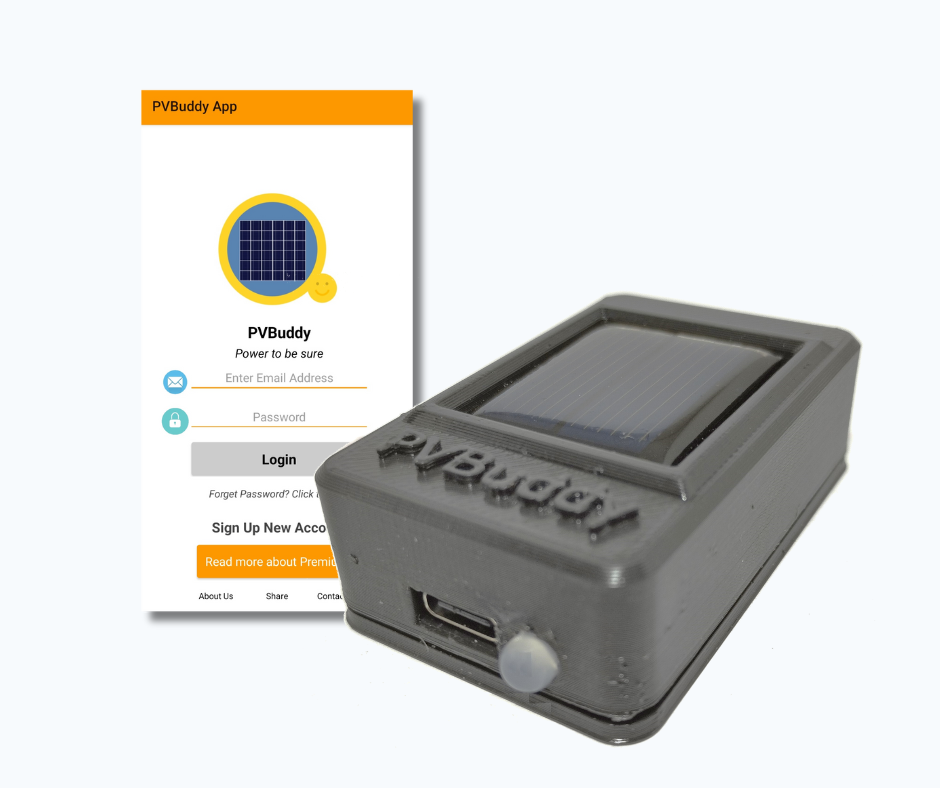
PVBuddy PVS01 is designed around practical comparative PV field checking rather than pretending to replace a laboratory irradiance measurement system.
Flexi-Cal™
The PVS01 sensor can be tuned against the inverter kWh reading for a representative PV string, or strings with the same orientation.
Alternatively, where the user has an appropriate laboratory-calibrated irradiance meter, the PVS01 can be tuned against that reference.
Once the reference has been established, subsequent measurements can be compared with the reference to look for changes under comparable sunlight conditions.
This is the idea behind PVBuddy's Flexi-Cal™ approach: flexible reference setting according to the user's application.
A typical inverter-reference test
The basic concept is deliberately simple.
Select the test area
Select the module, string or group of strings to be assessed and place the PVS01 sensor in the same orientation.
Establish the reference
Check the inverter kWh reading and tune the sensor using the PVBuddy App for that string or for strings having the same orientation.
Repeat the test
Place the sensor in the same test position and orientation under comparable, stable sunlight conditions.
Compare
Compare the new measurement with the established reference and investigate any meaningful or repeatable deviation.
What does a change in irradiance tell you?
A change in measured irradiance can tell you that the solar input at the test location is different.
It does not, by itself, diagnose the reason for a change in PV electrical performance.
For example, if a PV string produces less energy during a test, the cause could potentially involve sunlight conditions, shading, soiling, temperature, module condition, electrical connections, inverter operation or other factors.
If a repeatable deviation is detected, further testing may be appropriate.
Who can benefit from understanding irradiance?
You do not have to be a professional solar engineer to benefit from understanding the concept.
- Home PV owners who want to understand changes in their system.
- PV installers and technicians carrying out practical field observations.
- PV module recyclers who need a practical way to compare modules or groups of modules.
- Schools and training centres teaching students about solar energy and sensors.
- DIY enthusiasts interested in measuring and understanding their own solar installation.
Five things to remember about irradiance
- Irradiance describes the solar power arriving at a surface and is commonly expressed in W/m².
- PV electrical output is affected by the solar conditions at the modules.
- Comparing measurements under substantially different sunlight conditions can lead to misleading conclusions.
- Sensor orientation should be consistent when making comparative measurements.
- A practical relative reference is not the same thing as a formally calibrated, traceable irradiance measurement.
Sometimes the useful question is simply "Has it changed?"
Solar PV testing does not always need to begin with a search for a complicated fault.
Sometimes the first useful observation is that something has changed.
If you can establish a repeatable reference and then compare future observations under suitable conditions, you have a practical starting point for deciding whether further investigation is worthwhile.
That is where understanding irradiance becomes useful.
It helps put the electrical number from the inverter into the context of the sunlight that was actually available to the PV system.
Want to try comparative PV checking?
Explore PVBuddy PVS01 and its Flexi-Cal™ approach to establishing a practical PV reference.
View PVS01Continue reading
If you are new to PV performance checking, start with: Is Your Solar PV System Still Performing as It Should?
For practical information about different types of measurement equipment, continue with: Types of Solar Irradiance Meters .